

Is Your Team Overwhelmed Too?
Your accountant groans every time you ask to see the site results. Your estimator needs two weeks to prepare an urgently needed quote. Your planner has no capacity left for quantity surveying. Your site manager sits in the site office writing reports instead of running the site.
I know how construction companies operate. For more than 30 years, I have worked as a site manager, estimator, sales director, and managing director. In these roles, I was responsible for construction companies ranging from 100 to over 6,000 employees. I have seen how construction projects are organized not only in Germany, but also in the USA, India, and the UAE.
A reliable way out of the vicious circle of overload, rising personnel costs, and poor results is the comprehensive digitalization of all company processes. Yes, you read that right: all processes. There is little point in walking across the site with a clipboard in one hand and a tablet in the other.
Digitalizing a construction company is a major change. You don’t simply buy software and a few new computers and expect everything to run smoothly from day one. It is a transformation of the entire company. The change process needs to be carefully planned and executed.
Where does the construction industry stand?
Today’s construction sites could, in many respects, resemble those of a hundred years ago: manual bricklaying, paper plans, and scaffolding towers. With a turnover of 12 trillion dollars, the architecture, engineering, and construction (AEC) industry is one of the largest sectors in the world, yet it has historically been among the slowest to digitalize and innovate – a finding from a McKinsey & Company study (1).
Our industry is lagging behind in digitalization. So do you still have plenty of time? If you want a competitive edge, you need to act. There are already companies racing ahead of the industry and reaping the rewards.
Goldbeck has more than tripled its revenue over the past ten years, to over 5 billion euros. Digitalization is a key building block of that growth: using BIM, the company maps its entire planning, construction, and operations process digitally, as managing director Thorsten von Killisch-Horn reports (2). With Blue Buildings, Goldbeck can already tell customers today how sustainable their individual building will be throughout its construction and operational phases.
The large majority of construction companies surveyed in a recent PwC study (3) expect that today’s challenges and disruptions will give rise to entirely new business areas. The pressure to change is so significant that roughly half of all companies are planning, or have already begun, organizational restructuring.
“Digitalization, and the resulting differentiation from competitors, is an opportunity that companies should seize.”
Numerous publications focus primarily on BIM. Building Information Modeling describes a working method for the networked planning, construction, and management of buildings and other structures using software. The discussion centers mainly on how collaboration among all project participants within a single data model can make processes more efficient.
I believe it will be a very long time before all project participants actually share all data in one common database. But even that scenario would only help a construction company to a limited degree. The view remains restricted to a single project. A construction company is successful above all when coordination across projects leads to good capacity utilization. Which resources are needed on which project, and when, is not captured by project-level BIM. Nor does an organization-wide BIM make it any easier to reconcile staff presence on site with payroll and site controlling.
It is therefore far more important to digitalize and optimize all internal processes while keeping interfaces open for customer requirements at the same time.
What Does Digitalization Actually Mean?
Digitalization refers to the process of converting analog information and processes into digital formats. It is about using networked computers to make the way people and organizations communicate more efficient. Ultimately, it is also about how processes and tasks can be automated and how new business models can be generated.
So it is about far more than simply replacing paper with files on a computer. There are three stages of digitalization.

Stage 1: Replacing Paper with Files
In the first stage, paper is simply replaced by a file. The document is scanned and saved on a computer, usually as a PDF. Many construction companies already store these files in an organized way on servers. But this is of little use if not every project participant – whether on site, working from home, or in the office – can access them at any time. In some cases, a parallel paper filing system is still maintained “just to be safe.”
Stage 2: Mapping Processes Digitally
In the second stage, processes are actually mapped digitally in their entirety. Simple processes that are well suited as a starting point include things like vacation requests or investment decisions. Even though such processes may seem simple, they can become quite complex in larger companies.
With a vacation request, for example, it must be clear that the employee’s entitlement actually still exists, that their substitute is not also on leave at the same time, and that both the department head and the manager approve. Once approved, everyone involved should be informed, and the vacation days should ideally be booked automatically. Should the leave not be taken after all, or be cut short, a reversal must also be possible.
This small example shows that even simple workflows need to be carefully organized in detail if they are to run smoothly later on.
Stage 3: New Business Models Through Digitalization
The third stage is about new business models that only become possible through digitalization. A general contractor building single-family homes, for example, can automate large parts of plan approval, sample selection, and the choice of options – including additional and reduced costs – entirely online. This is a major relief and improvement for both contractors and clients. Disputes over additional costs that are sometimes only communicated after the work has been carried out become a thing of the past.
What Could New, Digital Business Models Look Like?
When people think of new business models, they naturally think of ConTech: start-ups that set out with software and other services to revolutionize the construction industry.
But one could also imagine a company specializing, for example, in using robots to automatically drill anchors into parking garage ceilings, install sprinkler systems, or paint facades.
Likewise, business models are conceivable that fully automate processes such as formwork construction or reinforcement production. AI-supported planning, design, and costing of entire buildings is already being discussed.
Does that sound far-fetched? Don’t you think you could reach new customers if your planning took place entirely within a BIM model in the future? If your customers could not only view the finished result through 3D glasses, but actually move through the building virtually and make decisions about flooring, windows, lighting, and workspaces – before the first spade even goes into the ground? That would finally put an end to mid-construction changes. You could plan your construction sequence optimally and would no longer have to justify why a disrupted schedule costs money.
Why Should I, as a Construction Business Owner, Even Deal With This?
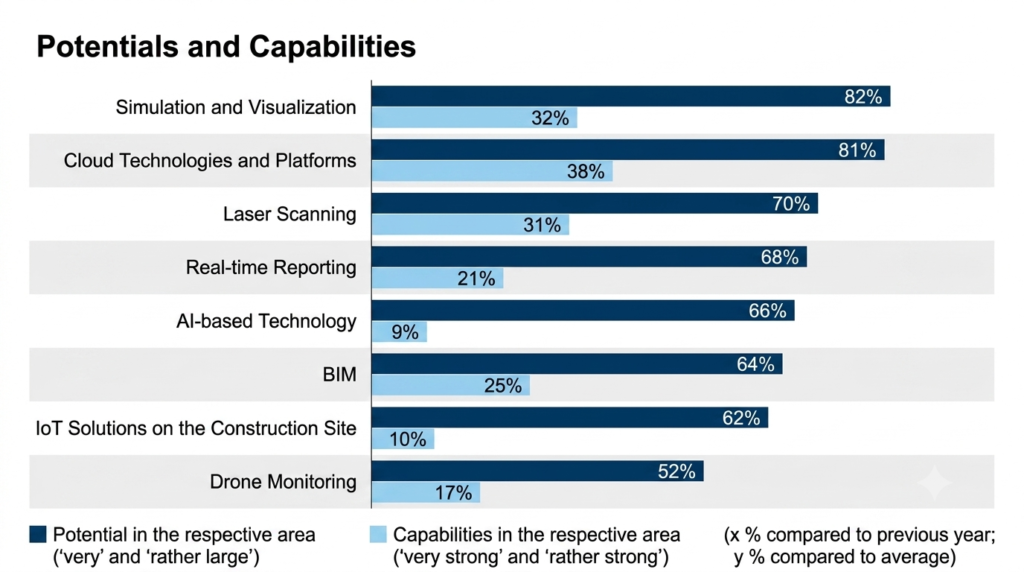
Because digitalization is associated with significant risk, because revenue is still possible without it, and because it is not seen as a driver of profit, it is often treated as a low priority – this is what a Fraunhofer IESE study (4) on the state of digitalization in the construction industry shows. Unfortunately, many business owners wrongly assume that investments in digitalization do not lead to higher profits.
“It is true that digitalization carries risks. Like any major change within a company, the process must be carefully planned and implemented. When done right, the measures will succeed in cutting costs, making sites more efficient, and taking the company to the next level.”
Many construction companies have already digitalized all their core processes, or are well on their way to doing so. This makes the steadily rising administrative demands manageable and significantly reduces the personnel effort required for administrative tasks.
Construction companies also become more attractive to the younger generation again. Which company do you think a young civil engineer would rather apply to, and where would a bricklayer rather train?
I have seen that in countries such as the UK or the USA, clients have for years increasingly demanded exclusively digital communication and documentation. This trend will soon reach the German market as well.
If you believe digitalization can give you an advantage, you should digitalize your company now. Later, it will no longer be a competitive advantage – it will simply be the standard.
And How Can I Actually Digitalize My Company?
Step 1: Concept and Team
You might think you can simply talk to your IT manager and let them handle it, right? Don’t even consider it for a second! Sure, they are competent and experienced. But they are not the right person to optimize your business processes – and that is exactly what this is fundamentally about. If you have a lean management officer, that person might be the right point of contact.
In any case, the digitalization lead must report directly to senior management. Otherwise, a change process of this scale is doomed to fail. Ideally, the digitalization lead should be familiar with process management, digitalization and IT, as well as change management. If you have someone in your company who covers many but not all of these areas, give them a few months to learn and develop professionally. If you go looking for the perfect candidate on the job market instead, it likely won’t go any faster.
The digitalization lead needs a team made up of representatives from every department, contributing either full-time or just a few hours a week, depending on the size of the company. Don’t skimp on external training for your team members. Proven concepts for digitalization exist in every area. You may also have business partners or friendly companies that are further along in certain respects – feel free to look at what and how they have implemented digitalization.
For the concept phase, it is important to get a detailed overview of your company’s IT landscape and database structures. You also need to precisely describe all company processes, especially all on-site processes. Back to the small example of the vacation request: in many companies, this is still a paper form today. The employee fills it out and puts it in the internal mail tray. Whoever picks it up next knows what to do with it. But often, nowhere is it written down exactly what happens to it, and at which step. If these detailed process descriptions don’t exist in your company yet, now is the time to create them.
The same applies to the pricing inquiry process during the quotation phase, to the costing and approval of quotes, and to every other company process. For each process, make a note of how you envision future improvements.
Please make sure this doesn’t turn into an academic paper or a rigid dogma. You could spend years writing process descriptions and specification documents. Here, you should bring courage to accept gaps and flexibility to embrace change. Also consider early on whether you want to bring in outside professional help. It costs money, but it significantly reduces the risk of failed attempts and frustrated employees.
Step 2: Selecting the Tools
In the course of comprehensive digitalization, you may need to say goodbye to some beloved tools. The rule should be that for every type of task in the company, there is only one software solution. Everyone uses the same costing program, the same scheduling software, and so on.
Choosing the right software matters. Get an overview of the market and evaluate the options carefully. Talk to existing users of the programs as well. Functionality is important, but ease of learning is often even more important than the flashiest features!
Don’t forget to involve your IT department at the latest when testing the software.
“The Fraunhofer study (4) points out that the potential of digitalization is especially large when companies move away from isolated solutions and toward comprehensive system integration – from planning software all the way to the machinery itself”
It is also important that the programs have modern, intuitive user interfaces while allowing everyone involved to access the same data – whether from an office desk, a laptop, a tablet, or a mobile phone. Open and well-documented interfaces must be available, including interfaces to older data exchange formats that are still common in the industry, such as the GAEB formats used for tendering and contract awards in Germany. Keep in mind that international software packages often struggle with country-specific requirements, such as the German “Urkalkulation” base costing sheet or the well-known “EFB” forms. Naturally, the software must also comply with German data protection regulations.
Assume that with modern software, you will hardly need an in-house server anymore, since data is stored in the cloud. This shift should also be discussed early on with your IT team. Administrative overhead should be reviewed and addressed. Secure, single sign-on access to the various software packages – without having to enter passwords every time – is important.
Naturally, also pay attention to pricing and to the companies behind the software.
Step 3: Communication
As with any change process, communication is a critical success factor. Digitalization must never be a secret, top-down initiative. Involve the relevant departments in the software selection process. Communicate the planned digitalization early on, with a realistic timeline and budget. Introduce the digitalization lead personally within the company as a member of senior management. Provide regular updates on upcoming goals, steps, successes, and setbacks. Make it unmistakably clear to employees that constructive criticism is welcome, but that participation itself is not optional.
Naturally, you should also communicate the successful rollout to your key stakeholders once it’s complete.
Step 4: Timeline and Rollout
I honestly cannot give you a reliable timeframe here. It depends heavily on your processes, your current level of digitalization, your employees, and your goals.
Such pilot trials will also reveal training needs. While introducing a workflow for sick leave notifications might only require an email announcement, more complex programs will certainly require proper training. Training for key users can sometimes be conducted by the software provider itself. Other training is best delivered on-site, at the workplace, or online.
RKeep in mind that it’s just as important to formally end the old way of doing things at the right moment as it is to introduce the new digital process. Otherwise, there will always be employees who cling to old habits until retirement.
Step 5: Status Check and Next Steps
There may be situations where the carefully laid-out roadmap needs to change. The software vendor fails to deliver promised new features, employees don’t have time for essential training, or a program simply turns out to be unsuitable. Don’t let this throw you off course. You and your company are venturing into new territory, and you won’t get everything perfectly right from the start. That’s why it’s important to build sufficient flexibility into your budget and timeline.
You will see: once digitalization succeeds, entirely new possibilities will suddenly emerge that you never even considered. Since all company information is now available online in a structured way, AI can, for example, help you find every document related to a supplementary claim in seconds. You can gain insights from your figures and equipment data that significantly improve the costing of new projects.
Hopefully, your site managers can now focus on the site again, instead of working through a mountain of overtime.
Don’t make any plans for the future before digitalizing your company’s processes. You’ll be surprised how much creativity your employees can bring to developing new business models!
What Does This Mean in Practice for the Use of AI?
The introduction of AI presupposes digitalization. This is often overlooked. You won’t get meaningful results if, during an analysis, the AI only has access to part of the information. Anyone running AI on a foundation of disconnected systems, half-maintained folder structures, and leftover paper files will be disappointed.
Even with AI, reviewing correspondence still benefits from proper categorization and an organized project filing structure right from the moment documents come in. Otherwise, there is a real risk that documents get overlooked. The context also becomes far too large if the AI always has to review every single document instead of accessing exactly the relevant ones. Depending on the company, categorization, tagging, and summarization can, by the way, also be handled by a locally installed AI – an important point especially when it comes to sensitive project data.
A simple, illustrative example of AI in action, from my own experience:
Construction companies typically spend an enormous amount of time, right when an inquiry comes in, just to identify the essentials: location, customer, contract and payment terms, bid and execution deadlines, and the type and scope of the work involved. An AI can handle this completely independently, without any issue, and then – after review by a decision-maker – even draft the response to the party issuing the tender, whether that’s a decline, an acceptance, or further questions.
Another example: an email generator can help draft, answer, or review standard correspondence, while taking spelling, legal accuracy, and company-specific conventions into account.
These examples show what this is really about: AI is not a substitute for digitalization, it is its reward. Only once your processes and data are organized, structured, and accessible can AI truly unlock its potential.
Conclusion
Digitalizing your construction company is not an IT project, it is a change process that must be driven by senior management. Companies that follow this path consistently – with a clear concept, the right software, open communication, and realistic timelines – create not only relief for overburdened employees, but also the foundation for the next step: the meaningful use of AI.
Sources
(1) From start-up to scale-up: Accelerating growth in construction technology. McKinsey & Partners, 2023. Jose Luis Blanco, David Rockhill, Aditya Sanghvi, Alberto Torres
(2) Article by about Goldbeck in the “Fachzeitschrift für Familienunternehmen”. The News. May 2024. Livia Brans.
https://dienews.net/artikel/digital-nachhaltig-innovativ/
(3) PwC-Studie 2025 zum Umgang der Baubranche mit aktuellen Herausforderungen. PricewaterhouseCoopers
https://www.pwc.de/de/risk-regulatory/risk/capital-projects-and-infrastructure/bauindustrie-unter-druck.html
(4) Study: Status of digitalisation in the construction industry. Fraunhofer IESE. 12.05.2023. Denis Feth, Thomas Jeswein and Stefanie Ludborzs.
https://www.iese.fraunhofer.de/blog/digitalisierung-baubranche-studie/