
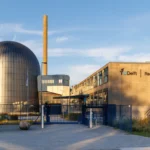
My Take (Arnulf Christa): A full-scale digital twin before ground-breaking: advanced reactor construction demands millimeter precision and near-zero tolerance for on-site coordination errors. This is the template for tomorrow's critical infrastructure projects—European contractors must master digital simulation and virtual assembly or risk exclusion from the world's highest-value construction programs.
TerraPower’s Natrium project, supported by a public-private partnership with the U.S. Department of Energy’s Advanced Reactor Demonstration Program (ARDP), has reached a significant milestone through the deployment of a comprehensive digital twin and full-scale training simulator at the Kemmerer site in Wyoming. The estimated project value is approximately EUR 3.6 billion (USD 4 billion), with construction commencing in April 2026 and commercial operation targeted for 2030–2031. The facility will feature a 345-megawatt sodium-cooled fast reactor capable of ramping to 500 megawatts through integrated molten-salt thermal energy storage, providing both baseload power and energy storage capabilities.
The digital twin represents a revolutionary application of advanced modeling technology to nuclear construction. Every component of the Natrium facility—from reactor vessel internals to balance-of-plant systems—has been modeled with millimeter-level precision in a virtual environment. This allows engineering teams to perform a complete ‘virtual assembly’ before physical components arrive from multiple international suppliers, enabling early identification of fit, interference, and logistics issues that would otherwise emerge on-site. The approach significantly enhances construction coordination, reduces rework, and accelerates schedule certainty for a project of this complexity and capital intensity.
The Natrium project holds global significance as the first commercial-scale advanced reactor construction in the modern generation of next-generation nuclear technology. Its success carries strategic implications for nuclear energy policy in Europe and North America, demonstrating both the technical and financial viability of advanced reactors as part of decarbonization strategies. For the international construction and engineering community, the project exemplifies how digital-twin technology and immersive simulation can be applied to reduce risk and improve outcomes on megaprojects of unprecedented technical complexity.
Source: Construction Review Online